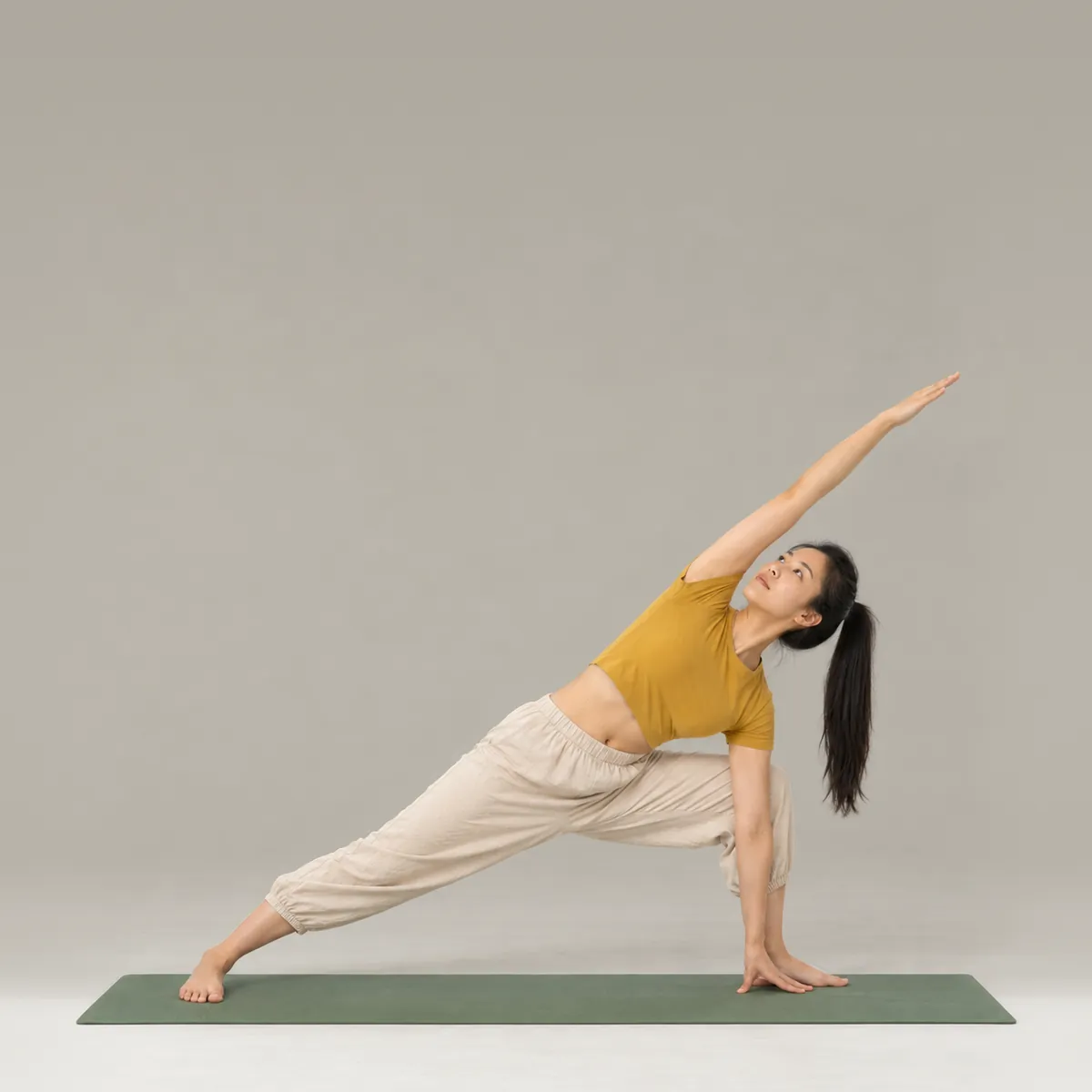
Revolved side angle
Parivrtta Parsvakonasana
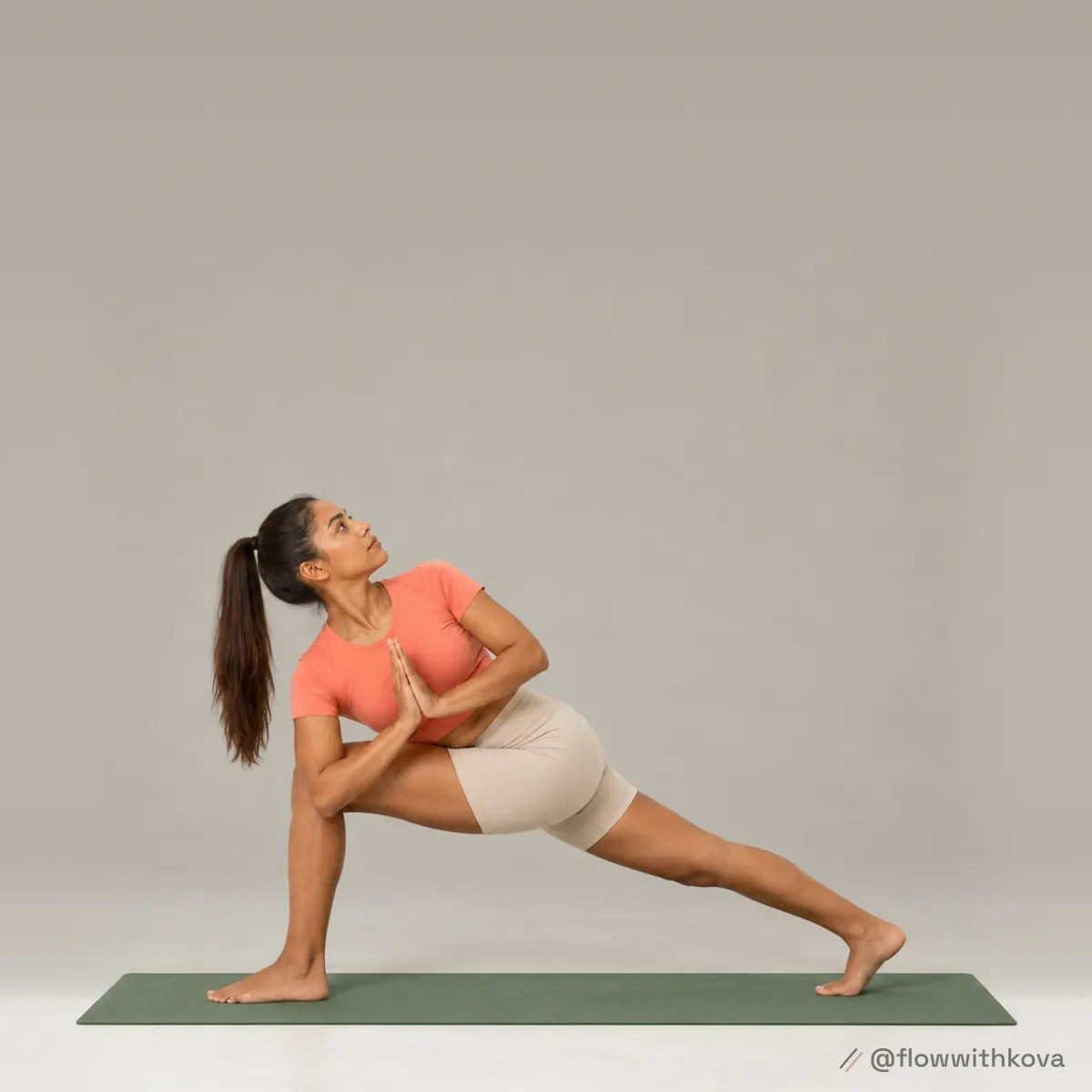
Revolved side angle is a twisting lunge where you hook one elbow outside the opposite knee and turn your chest toward the side. It builds strength in the legs and invites rotation through the upper back. Length comes first in this pose, so you twist from a tall spine rather than a rounded one.
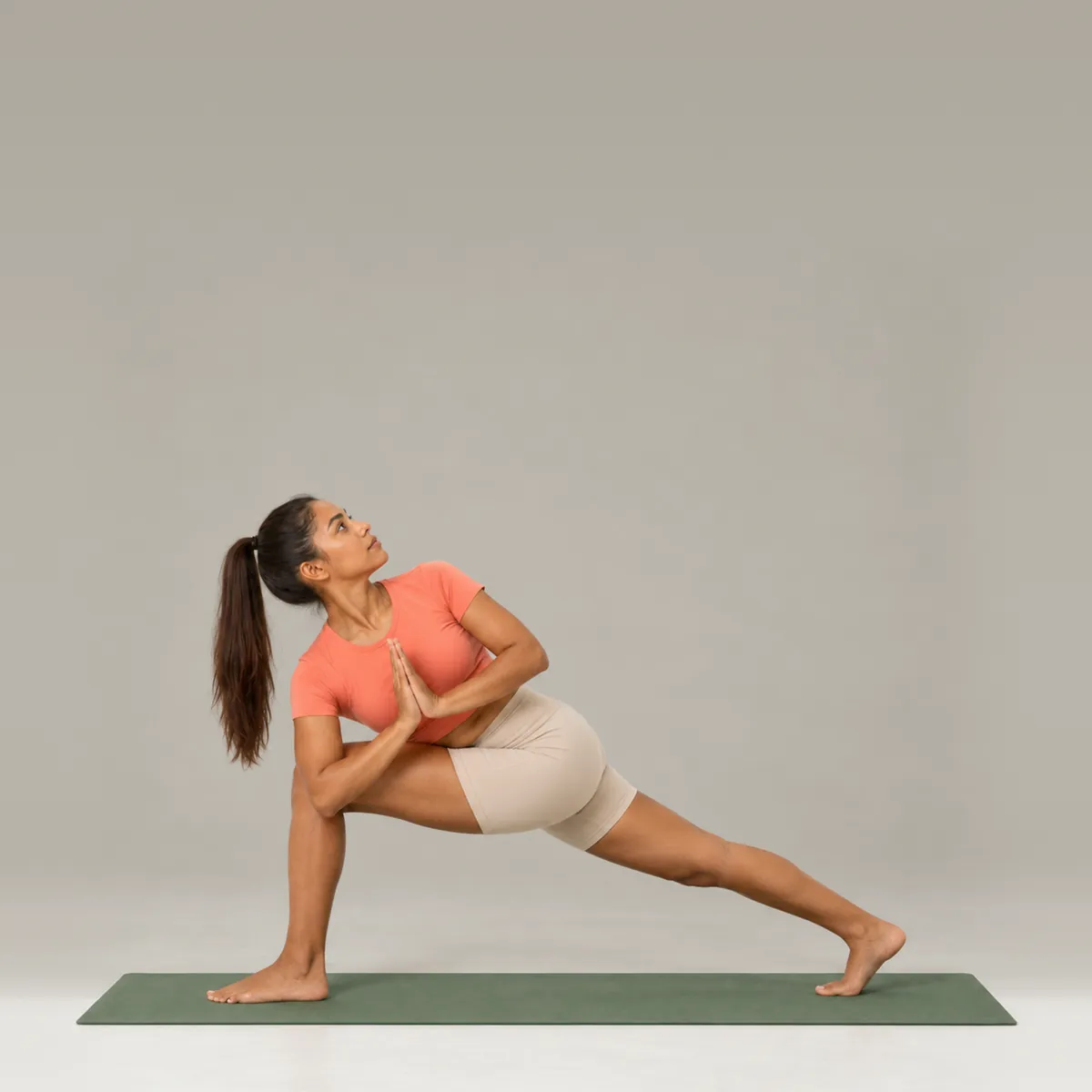
Spine stays long as you turn.
How to do Revolved side angle
Read each step once before you try it. Move slowly, and come out of the pose whenever your breath gets short.
- Level
- Intermediate
- Discipline
- Yoga
- Works
- Legs, Spine, Core, Hips
- Family
- Standing poses
- Also called
- Twisted side angle, Prayer twist
- 01
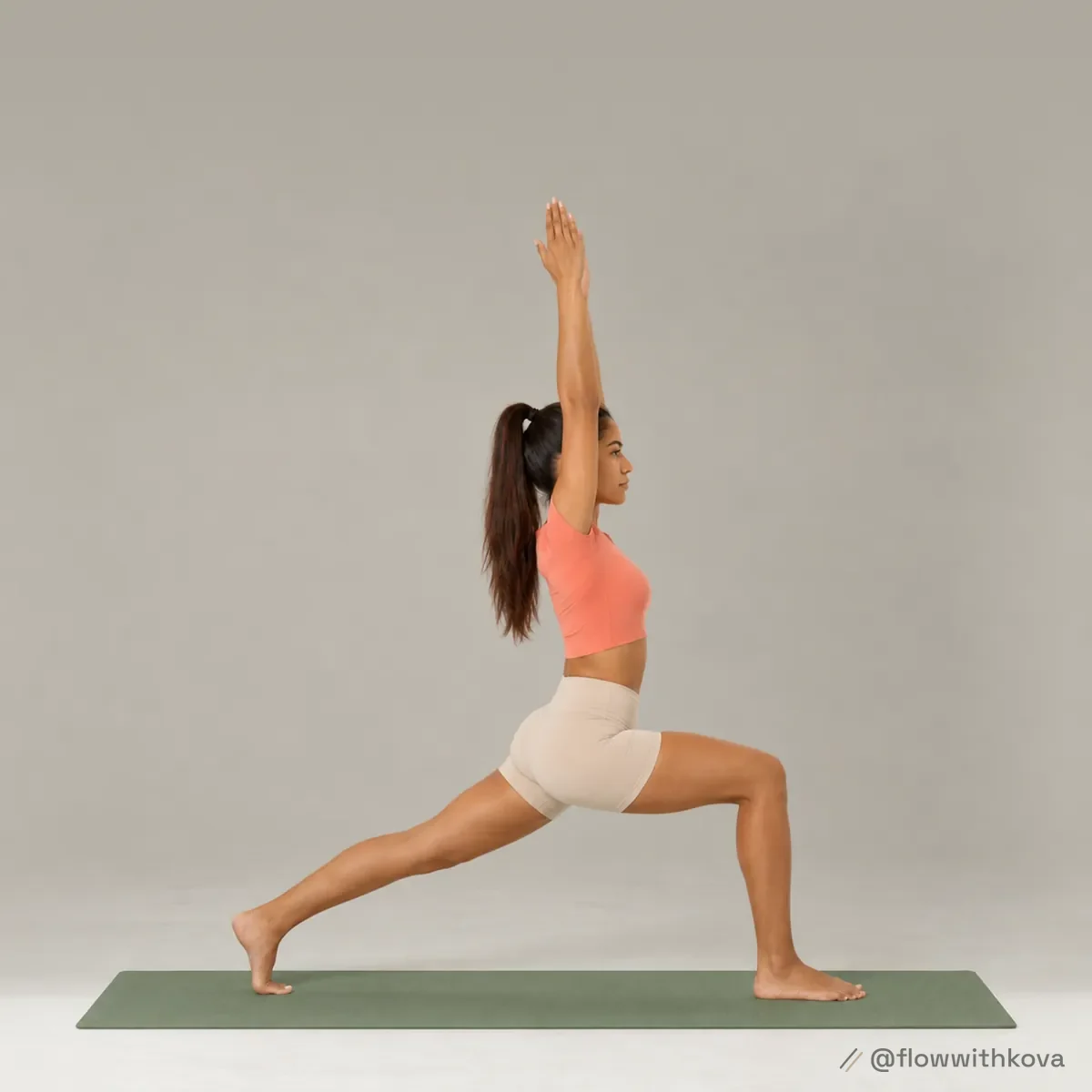
Start in crescent lunge with your right foot forward and your left heel lifted.
- 02
Bring your palms together in front of your chest.
- 03
Inhale to lengthen your spine, then exhale and twist your torso to the right.
- 04
Hook your left elbow on the outside of your right thigh, close to the knee.
- 05
Press your palms together to help turn your chest toward the side of the mat.
- 06
Keep your right knee over your ankle and your back leg long and strong.
- 07
Look to the side, or up if your neck feels comfortable.
- 08
Hold for five breaths, then unwind as you inhale, step back to downward dog, and switch sides.
Form checklist
What good form looks like.
Once you are in the pose, check these one at a time. If one slips, ease off a little until it comes back.
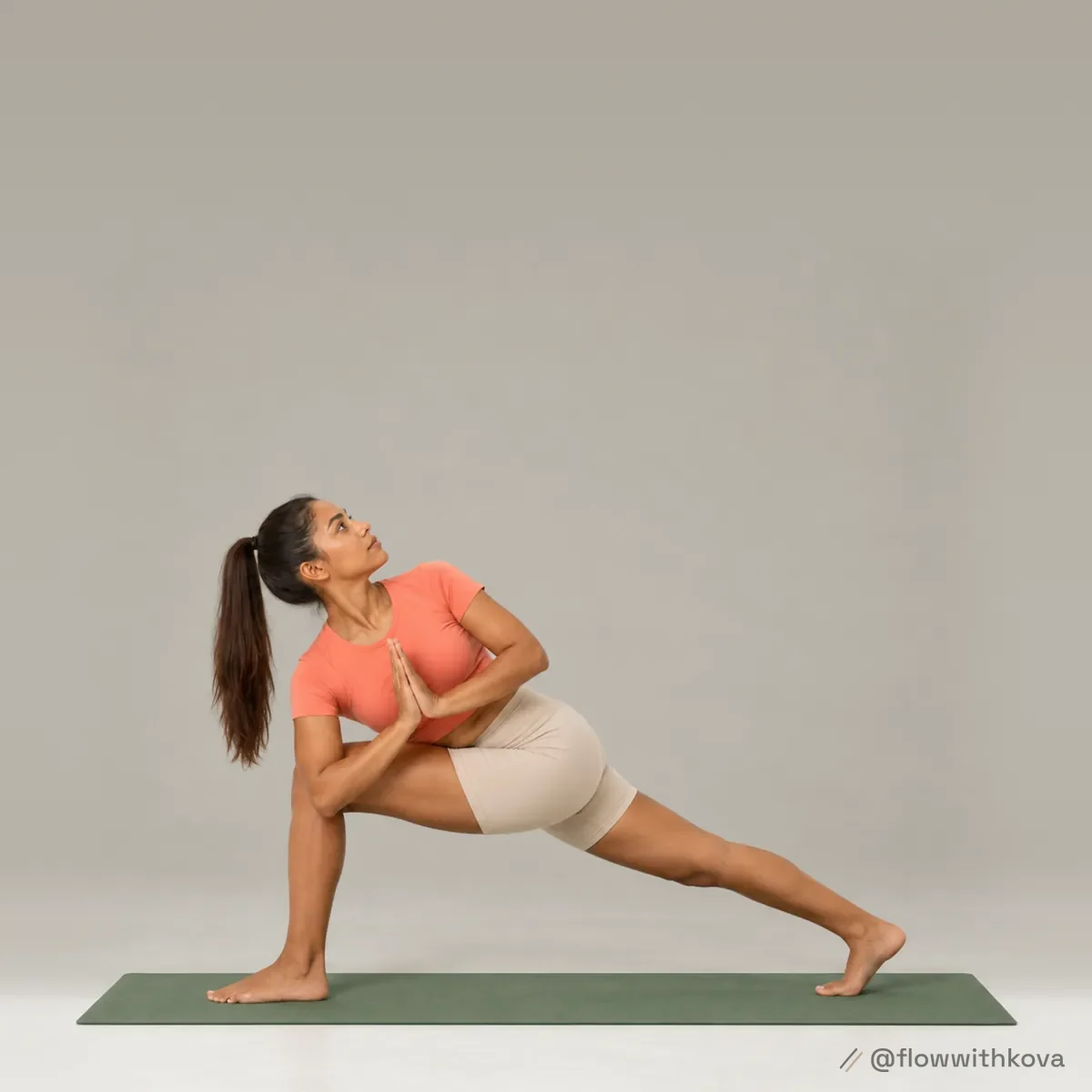
- 01Front knee stays over the ankle and points forward.
- 02Back leg stays straight and active.
- 03Spine stays long as you turn.
- 04Twist comes from the upper back, not just the arms.
- 05Palms press evenly together at the chest.
- 06Neck turns only as far as is comfortable.
Common mistakes and how to fix them.
Most of these are hard to feel from the inside, so check them one by one.
- 01
The elbow pushes the front knee inward.
The fix
Press your knee back against your elbow so they meet evenly, and keep your knee pointing over your middle toes.
- 02
The spine rounds to force a deeper twist.
The fix
Come up a little, lengthen through the crown of your head, then turn again as you exhale.
- 03
The back knee sags and the hips sink.
The fix
Lift the back of your thigh and press back through your heel, or lower the knee to the mat on purpose for a supported version.
- 04
The neck cranks up toward the ceiling.
The fix
Turn your gaze to the side or down until your neck feels at ease.
Modifications for your body
Easier and supported ways into the pose.
- Lower your back knee to the mat and pad it with a folded blanket.
- Keep your palms together at your chest instead of opening your arms.
- Place your lower hand on a block outside your front foot and reach your top arm up.
- Shorten your stance so the twist feels less intense.
Benefits over time
What regular practice of this pose can help with.
- Strengthens the thighs and glutes.
- Encourages rotation through the upper back.
- Builds balance and focus in a twist.
- Stretches the hip flexors of the back leg.
Breath
Inhale to grow tall and exhale to turn. If your breath feels cramped, ease out of the twist a little.
Take care
Take care with back, knee, or neck injuries, and twist only as far as feels comfortable. Build from crescent lunge and extended side angle first, and stop if you feel sharp pain. Kova is not a medical device and does not diagnose injuries.
By Fayeed PawaskarUpdated
Use this photo
This photo is free to use on your blog, in articles, newsletters, and class handouts. Keep the credit link to Kova. Image use terms
Download photo (WebP, 1200 x 1200)<figure>
<a href="https://www.flowwithkova.com/poses/revolved-side-angle"><img src="https://www.flowwithkova.com/pose-photos/revolved-side-angle.webp" alt="A woman in revolved side angle on a green yoga mat, twisting over her front knee with palms together" width="1200" height="1200" loading="lazy" style="max-width:100%;height:auto"></a>
<figcaption>Revolved side angle (Parivrtta Parsvakonasana). Photo: <a href="https://www.flowwithkova.com/poses/revolved-side-angle">Kova pose library</a></figcaption>
</figure>Practice with Kova
Get cued while you hold it.
Kova tracks your front knee and the turn of your shoulders with on-device pose tracking. If your elbow pushes your front knee inward or your back knee sinks toward the mat, a calm spoken cue helps you realign before you twist deeper.
- Pose tracking runs on your device. Your camera feed is never uploaded and never leaves your iPhone or iPad.
- Prefer no camera? Every session has an audio-only mode.
- Free to download on iPhone and iPad. Kova Plus starts with a 3-day free trial for new subscribers.
Revolved side angle questions
Back to the pose libraryWhere should my elbow go in revolved side angle?
Should my back knee be up or down in revolved side angle?
Why do I lose my balance in revolved side angle?


Practice it
with a coach.
Download Kova on your iPhone or iPad today. It is free to download, and Kova Plus starts with a 3-day free trial for new subscribers.
Download on the App Store