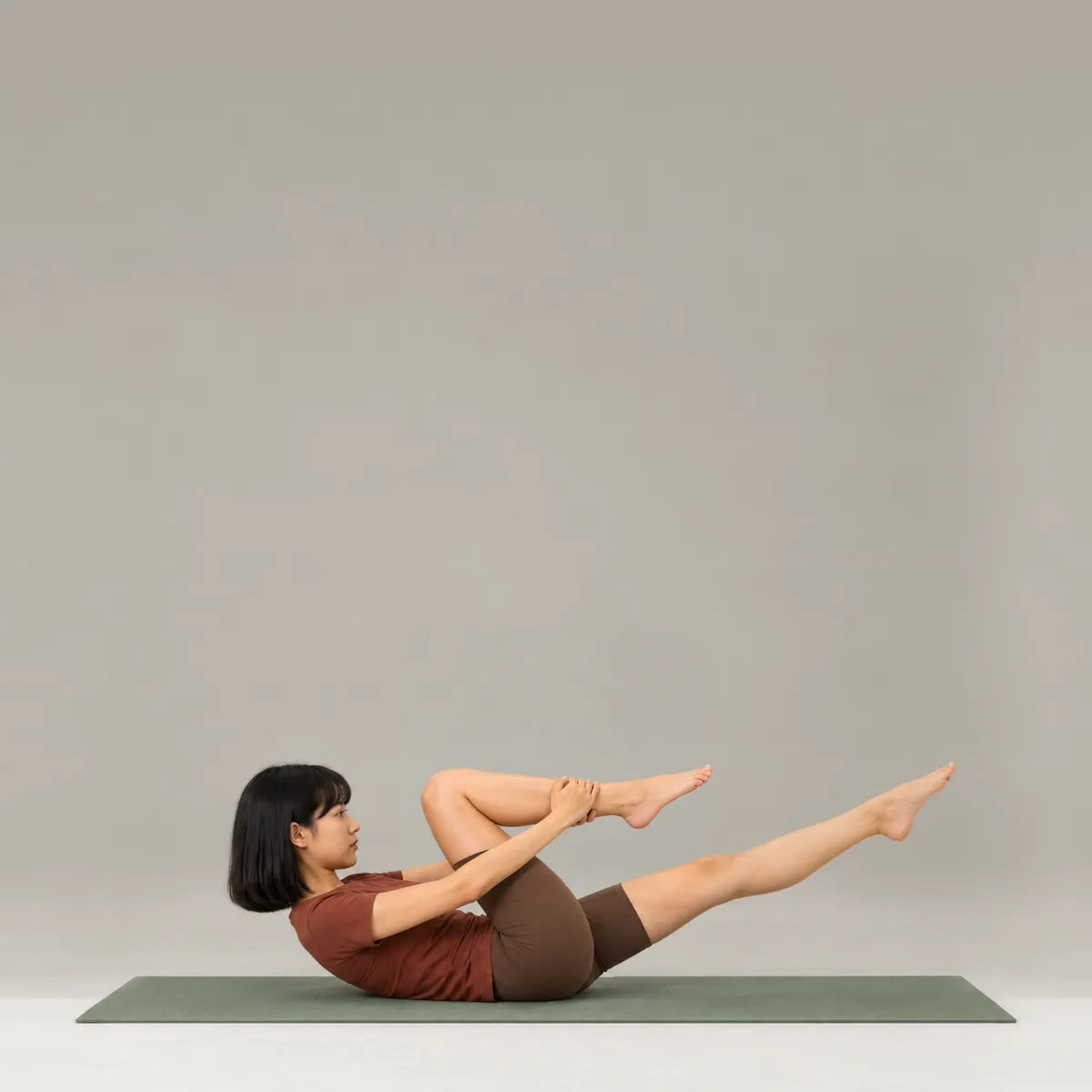
Criss-cross
A pilates mat exercise
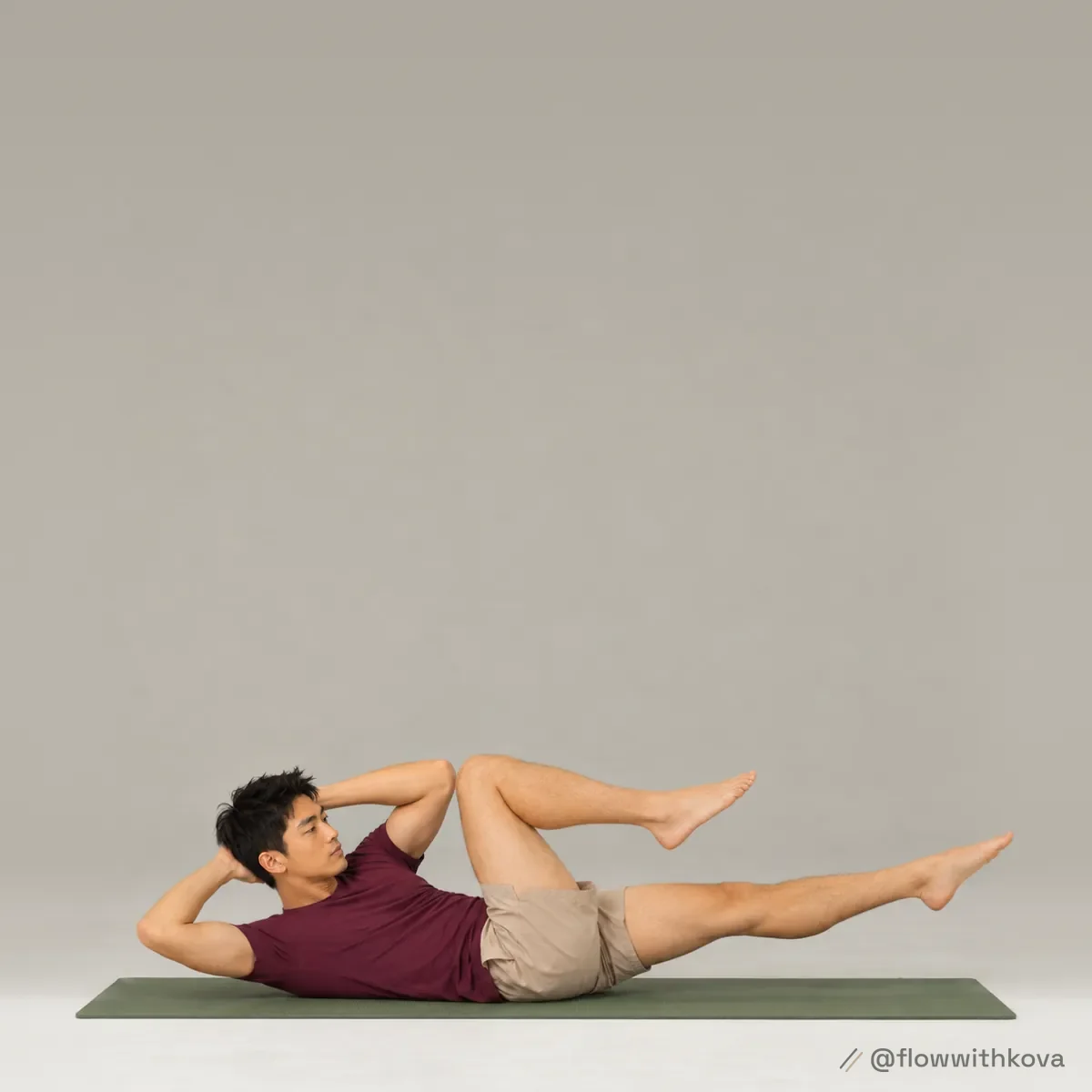
Criss-cross is a pilates mat exercise that adds rotation to the abdominal series, turning your upper body toward the opposite knee while the legs switch. It works the obliques along with the deeper core. Form matters because it is easy to pull on the head or flap the elbows, so the twist should come from the ribs while the pelvis stays still.
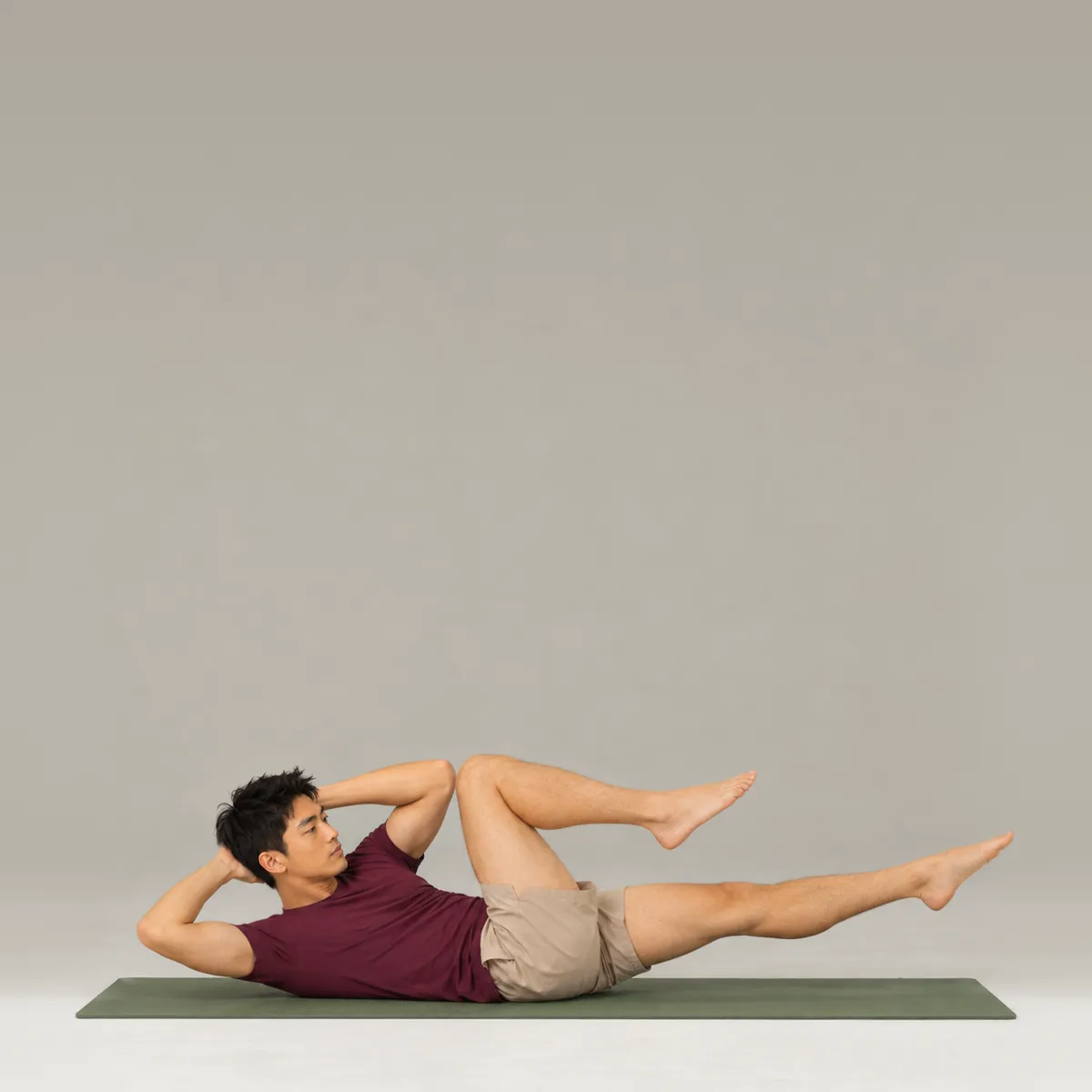
Elbows stay wide and open.
How to do Criss-cross
Read each step once before you try it. Move slowly, and come out of the pose whenever your breath gets short.
- Level
- Beginner
- Discipline
- Pilates
- Works
- Core, Obliques
- Family
- Pilates exercises
- Also called
- Pilates crisscross, Bicycle crunch
- 01
Lie on your back with your knees in tabletop and your hands behind your head, elbows wide.
- 02
Curl your head and shoulders up to the tips of your shoulder blades.
- 03
Extend your left leg long and draw your right knee in.
- 04
Exhale and rotate your upper body toward your right knee, bringing your left ribs across.
- 05
Inhale as you pass through center and switch legs.
- 06
Exhale and rotate toward your left knee, bringing your right ribs across.
- 07
Continue for five to eight reps on each side, then hug both knees in and lower your head.
Form checklist
What good form looks like.
Once you are in the pose, check these one at a time. If one slips, ease off a little until it comes back.
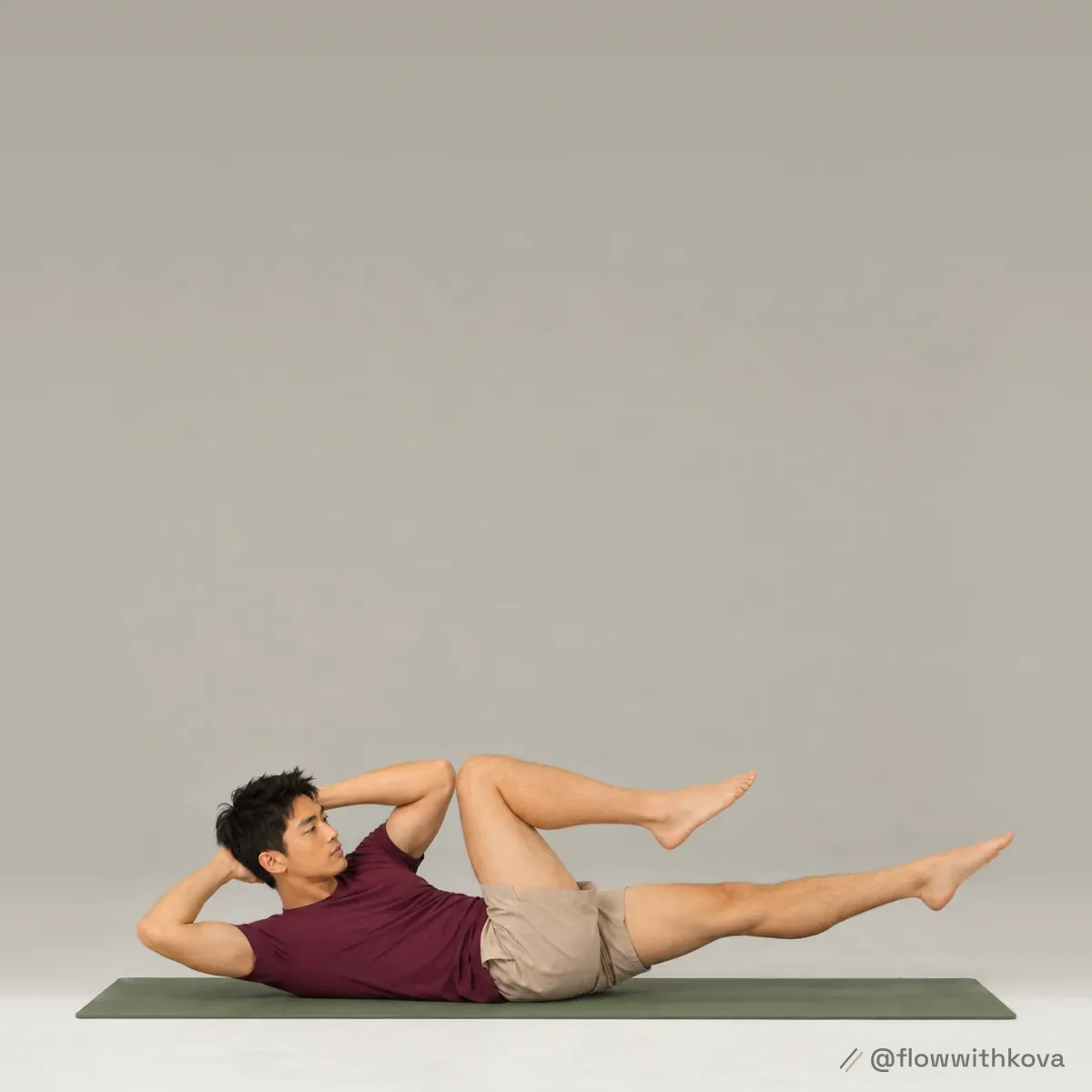
- 01Elbows stay wide and open.
- 02Rotation comes from the ribs, not the elbows.
- 03Pelvis stays still and level.
- 04Shoulders stay lifted through each twist.
- 05Hands support the head without pulling.
Common mistakes and how to fix them.
Most of these are hard to feel from the inside, so check them one by one.
- 01
The hands pull the head forward.
The fix
Keep your elbows wide and let your hands cradle your head. Think of your chest leading the turn.
- 02
Only the elbow moves toward the knee.
The fix
Rotate your whole ribcage so the opposite shoulder lifts and turns, rather than folding the elbow in.
- 03
The pelvis rocks side to side.
The fix
Slow down and keep both hips heavy on the mat while only the upper body turns.
- 04
The shoulders drop back to the mat between twists.
The fix
Stay lifted as you pass through center, or rest your head down between sets if your neck tires.
Modifications for your body
Easier and supported ways into the pose.
- Keep both feet on the mat and twist only the upper body.
- Hold the extended leg higher toward the ceiling.
- Pause for one breath in each twist instead of moving continuously.
- Rest your head down between reps if your neck needs a break.
Benefits over time
What regular practice of this pose can help with.
- Strengthens the obliques and deep abdominals.
- Trains controlled rotation through the upper back.
- Builds coordination between the upper and lower body.
Breath
Exhale as you rotate toward the bent knee, and inhale as you pass through center to switch sides.
Take care
Take care with neck or lower back injuries, and never pull on your head with your hands. If your neck strains, lower your head and rest, and stop if you feel sharp pain. Kova is not a medical device and does not diagnose injuries.
By Fayeed PawaskarUpdated
Use this photo
This photo is free to use on your blog, in articles, newsletters, and class handouts. Keep the credit link to Kova. Image use terms
Download photo (WebP, 1200 x 1200)<figure>
<a href="https://www.flowwithkova.com/poses/criss-cross"><img src="https://www.flowwithkova.com/pose-photos/criss-cross.webp" alt="A man doing pilates criss-cross on a green mat, hands behind his head and rotating toward one bent knee with the other leg extended" width="1200" height="1200" loading="lazy" style="max-width:100%;height:auto"></a>
<figcaption>Criss-cross. Photo: <a href="https://www.flowwithkova.com/poses/criss-cross">Kova pose library</a></figcaption>
</figure>Practice with Kova
Get cued while you hold it.
Kova tracks your shoulders, elbows, and hips with on-device pose tracking. If your elbows collapse toward your face or your hips rock as you twist, a calm cue reminds you to open the elbows and keep your pelvis steady.
- Pose tracking runs on your device. Your camera feed is never uploaded and never leaves your iPhone or iPad.
- Prefer no camera? Every session has an audio-only mode.
- Free to download on iPhone and iPad. Kova Plus starts with a 3-day free trial for new subscribers.
Criss-cross questions
Back to the pose libraryIs criss-cross the same as a bicycle crunch?
Why does my neck hurt doing criss-cross?
How many reps of criss-cross should I do?


Practice it
with a coach.
Download Kova on your iPhone or iPad today. It is free to download, and Kova Plus starts with a 3-day free trial for new subscribers.
Download on the App Store